

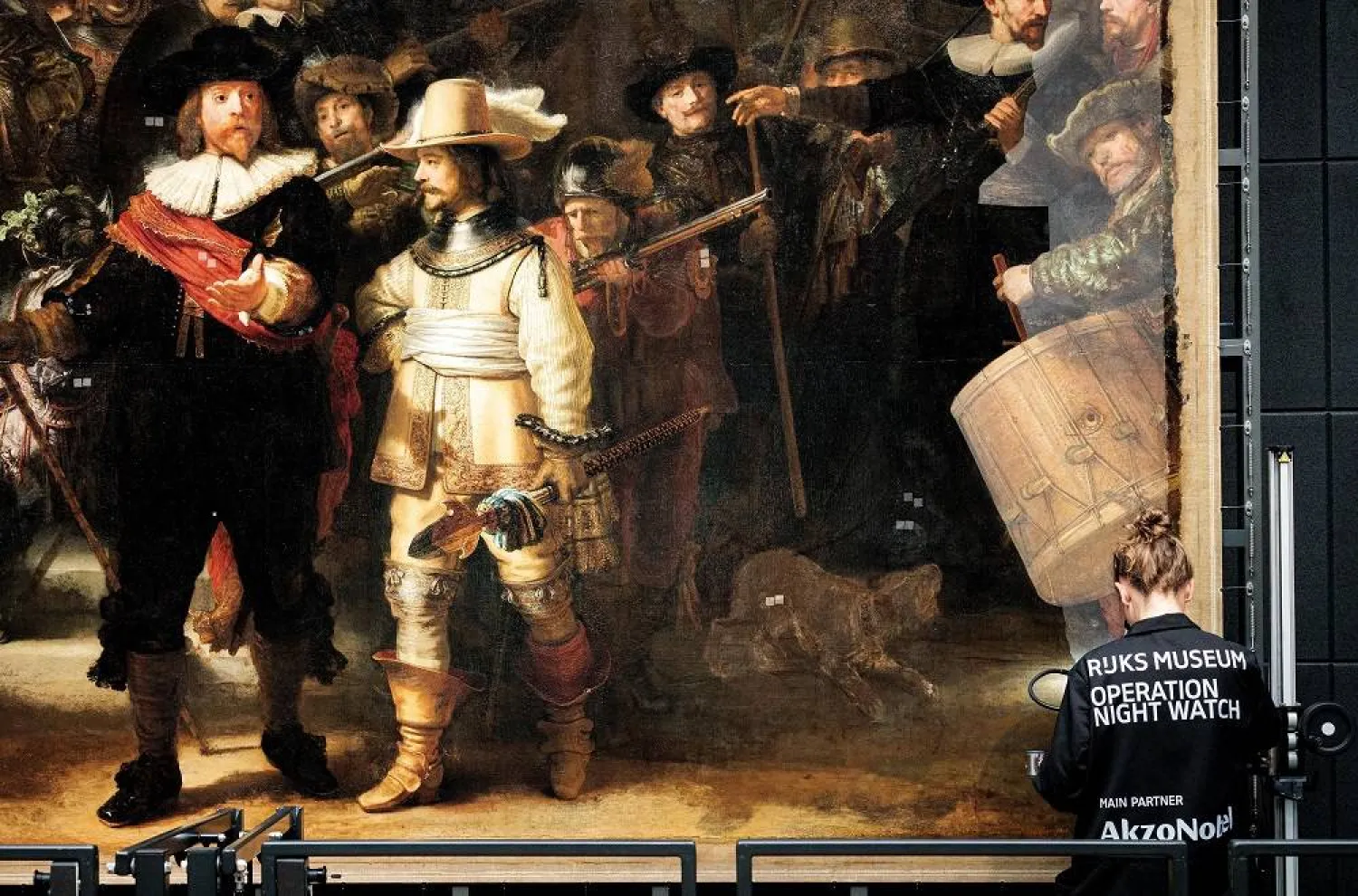

Rembrandt Copied Another Artist’s Canine for His Famous ‘Night Watch’ 

The painting "The Night Watch" by Dutch painter Rembrandt at the Rijksmuseum, in Amsterdam, the Netherlands, 23 September 2025. (EPA)
TT

Rembrandt Copied Another Artist’s Canine for His Famous ‘Night Watch’ 

The painting "The Night Watch" by Dutch painter Rembrandt at the Rijksmuseum, in Amsterdam, the Netherlands, 23 September 2025. (EPA)

It didn't exactly take dogged detective work for an art sleuth in Amsterdam to solve a canine conundrum dating back to the Dutch Golden Age.

Anne Lenders, a curator at the city's landmark Rijksmuseum, said Tuesday that it was more or less by accident that she discovered that the barking dog in Rembrandt van Rijn’s famous "Night Watch" is a near-identical copy of one that features in a 1619 pen and ink drawing by fellow Dutch artist Adriaen van de Venne.

"I wasn't looking for this; it was really unexpected," Lenders said in the glass room where "Night Watch" is undergoing extensive restoration.

She was visiting an exhibition at the Zeeuws Museum in the southern Netherlands when her eye fell on a picture of a dog by Van de Venne that was printed in a book by the poet Jacob Cats. The original drawing, which turned out to be part of the Rijksmuseum's own vast collection, was also on display

"The resemblance is so strong that at the very first moment I thought he (Rembrandt) must have used this," she added.

That's when the research started: a comparison of Van de Venne's and Rembrandt's dogs; their pose, even the collar they wear.

"The head turns in exact the same angle with the mouth slightly opened. ... Both dogs have long hair and ears that hang vertical," said Lenders.

In the "Night Watch," the dog adds tension to a dark corner of the crowded composition, crouching and apparently barking near a drummer called Jacob Jorisz and just behind one of the iconic 1642 painting's main characters, Lieutenant Willem van Ruytenburch.

The discovery is the latest in a series of revelations to emerge during a yearslong project to reexamine the 379.5 by 453.5-centimeter (149.4 by 178.5-inch) canvas using modern techniques. "Operation Night Watch" began in 2019 with an extensive study of the painting and is continuing with restoration work that is likely to take years to complete.

"One tends to think, well, it’s been researched so well, we know everything about it," Rijksmuseum Director Taco Dibbits said. "But the great thing with great art is that you always keep discovering things."

One thing the Rijksmuseum couldn't figure out was exactly what kind of dog it is, with expert opinions divided between a French or a Dutch breed. Most likely, the two artists used a little poetic license.

"We will never have a conclusion on which breed it is," Dibbits said. "But it’s definitely very much loved."



Saudi Pavilion at Makkah's Global Village Showcases the Kingdom’s Culture

Saudi Pavilion at Makkah's Global Village Showcases the Kingdom’s Culture
TT

Saudi Pavilion at Makkah's Global Village Showcases the Kingdom’s Culture

Saudi Pavilion at Makkah's Global Village Showcases the Kingdom’s Culture

The Saudi pavilion at Global Village in Makkah, part of the Makkah winter season, reflects the richness and uniqueness of the Kingdom's culture and heritage.

It features interactive and engaging sections that introduce visitors to the Kingdom’s cultural heritage, including live demonstrations of traditional handicrafts and artwork inspired by the local environment, SPA reported.

The pavilion’s presence at Global Village reflects ongoing efforts to highlight the nation’s cultural heritage, promote its civilizational legacy, and strengthen its cultural presence at major events.


Culinary Arts Commission Joins 17th Klija Festival in Buraidah as Strategic Partner

Culinary Arts Commission Joins 17th Klija Festival in Buraidah as Strategic Partner
TT

Culinary Arts Commission Joins 17th Klija Festival in Buraidah as Strategic Partner

Culinary Arts Commission Joins 17th Klija Festival in Buraidah as Strategic Partner

The Culinary Arts Commission is participating as a strategic partner in the 17th Klija Festival, held in the city of Buraidah and running until January 17, under the patronage of Qassim Region Governor Prince Dr. Faisal bin Mishaal.

The commission’s involvement comes as part of its strategy to support events and festivals specializing in Saudi culinary arts by highlighting national and regional dishes and showcasing the Kingdom’s culinary and cultural diversity, SPA reported.

The festival features several zones and interactive activities aimed at supporting families working in the cottage industry and local artisans who produce Klija, while introducing visitors to its history and authenticity as a regional dish of Qassim, in addition to offering live demonstrations and unique interactive experiences.

During the festival, the commission is also presenting a selection of books available for viewing and purchase.


Jeddah’s Red Sea Museum Announces January Cultural Program

The program's themes span traditional architecture, historical photography, music, travel literature, and the history of navigation and public health in the Red Sea. (SPA)
TT

Jeddah’s Red Sea Museum Announces January Cultural Program

The program's themes span traditional architecture, historical photography, music, travel literature, and the history of navigation and public health in the Red Sea. (SPA)

Jeddah's Red Sea Museum announced the launch of its public program for January 2026, featuring a series of artistic workshops, cultural talks, live performances, and family activities. The program aims to connect the Red Sea's cultural heritage with contemporary creative practices, catering to various segments of society.

The program's themes span traditional architecture, historical photography, music, travel literature, and the history of navigation and public health in the Red Sea. These activities are presented through a cultural and educational agenda held across the museum's facilities and venues in Historic Jeddah.

The program begins on Tuesday, with a workshop titled "Junior Cartographers" in the Discovery Room, where children aged 6 to 12 will explore the art of mapmaking and the fundamentals of navigation through an engaging, interactive approach. On January 15, the "Alchemy of Light: Albumen Prints" workshop will be held at the auditorium, highlighting the historical albumen printing technique using egg whites and silver salts, and exploring 19th-century photography aesthetics through a contemporary perspective.

On January 17, a talk about Historic Jeddah will discuss traditional architecture and its relationship to heritage and modernity. This will be followed on January 18, by the "Navigation from Past to Present" workshop at the auditorium, offering an interactive experience that explores the evolution of navigation methods through hands-on artistic and practical activities.

On January 22, the program includes the screening of the animated film "The Menace from Above" at the auditorium. Later that evening, Bab Al-Bunt Courtyard will host the Al Nour Wal Amal Orchestra, the world's only musical ensemble composed entirely of blind female musicians who perform using Braille musical notation, in a performance celebrating art, resilience, and diversity.

On January 23, an artist talk titled "The Gate of Gates" will be held in Historic Jeddah, documenting the transformations of the Bab Al-Bunt building and the human stories connected to this historic space. On January 28, the auditorium will host a talk titled "Encounters: Travel Literature," exploring journeys to Andalusia and Sicily and how Islamic heritage continues to live on through people and places.

The program concludes on January 31, with a lecture examining the development of quarantine systems and public health monitoring in the Red Sea, highlighting the historical role of Bab Al-Bunt as a quarantine center for pilgrims.

The Red Sea Museum's activities serve as a cultural and knowledge platform dedicated to documenting the Red Sea's tangible, intangible, and natural heritage, and presenting it through educational and interactive programs that foster dialogue between the past and the present, linking heritage with contemporary creative contexts from its headquarters in Historic Jeddah.